CLZ-280 - NAT Gateway Outbound
Goal
Make private-subnet Internet egress explicit and stable by associating a NAT Gateway and Standard public IP with the web subnet.
Prerequisites
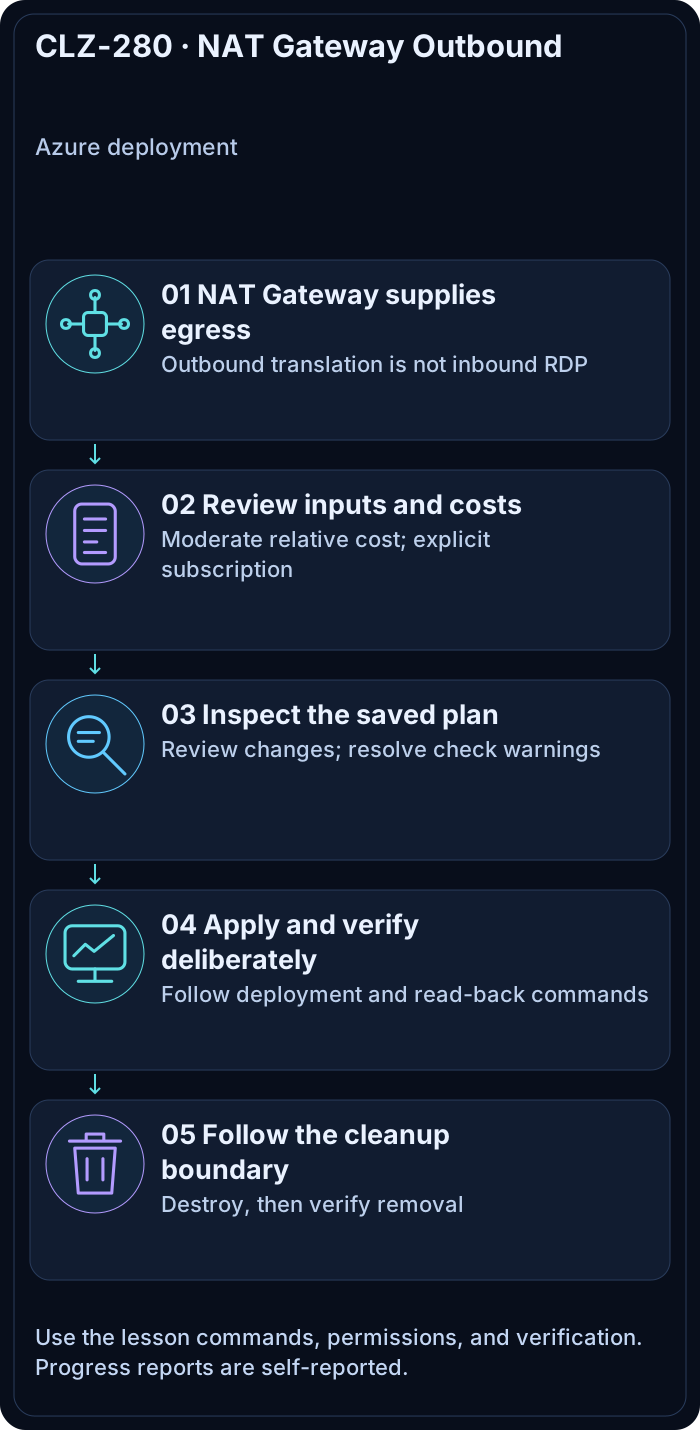
- Complete CLZ-270.
- Understand the difference between inbound access and outbound source translation.
Architecture
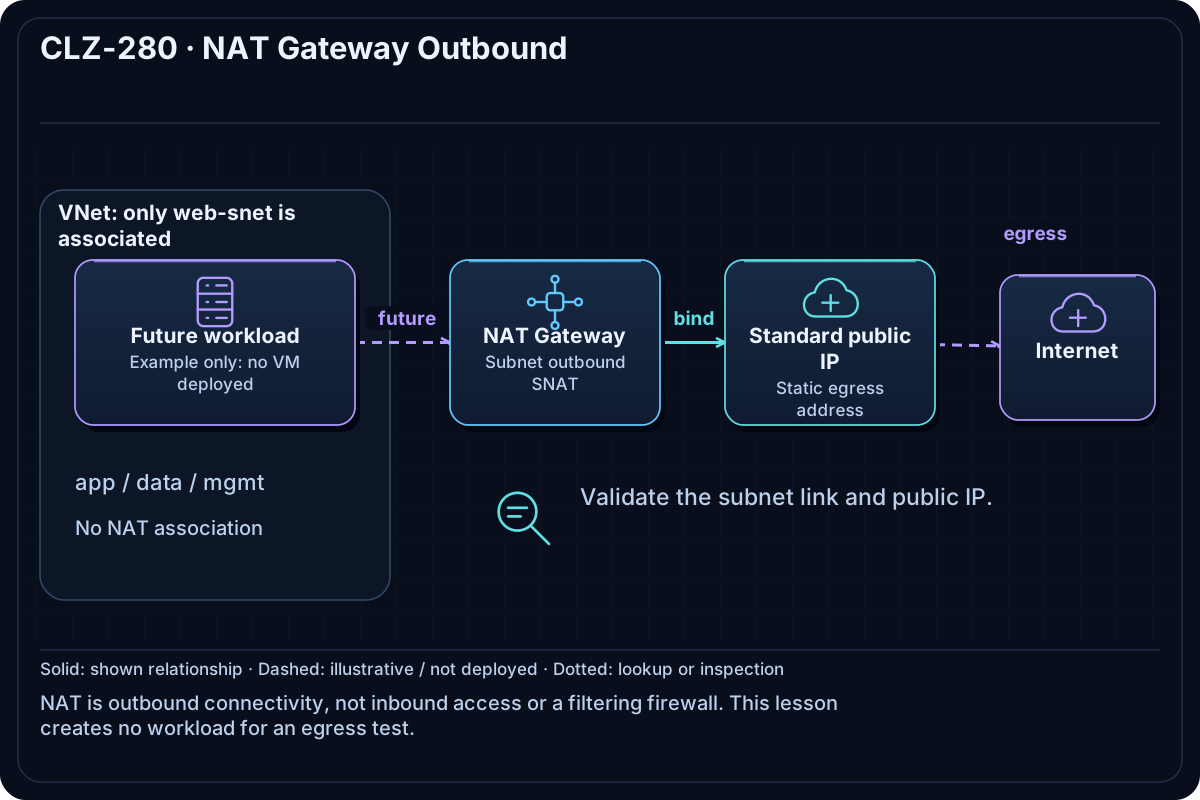
The web subnet has no public workload or inbound service. A NAT Gateway association makes its future outbound connections use one allocated Standard public IPv4. Other subnets are not associated, making the scope visible.
Resources And Cost
Relative cost: Moderate. NAT Gateway has an hourly charge and per-GB processing charge; the Standard public IP is also billable.
| Component | Purpose and principal cost driver |
|---|---|
| NAT Gateway | Subnet-level outbound source NAT; hourly and data-processing cost. |
| Standard public IP | Stable outbound identity. |
| VNet and subnets | Only the web subnet is associated in this lesson. |
Inputs
| Input | Required substitution or decision |
|---|---|
subscription_id |
Required for Azure plan, apply, and destroy; use the exact subscription GUID. |
environment |
Keep dev for the lab unless testing another environment boundary. |
location |
Select a supported region with sufficient quota. |
name_prefix |
Use a short lowercase prefix. |
Keep real subscription IDs, CIDRs, domains, endpoint names, and secrets in untracked local files or environment variables.
Deploy
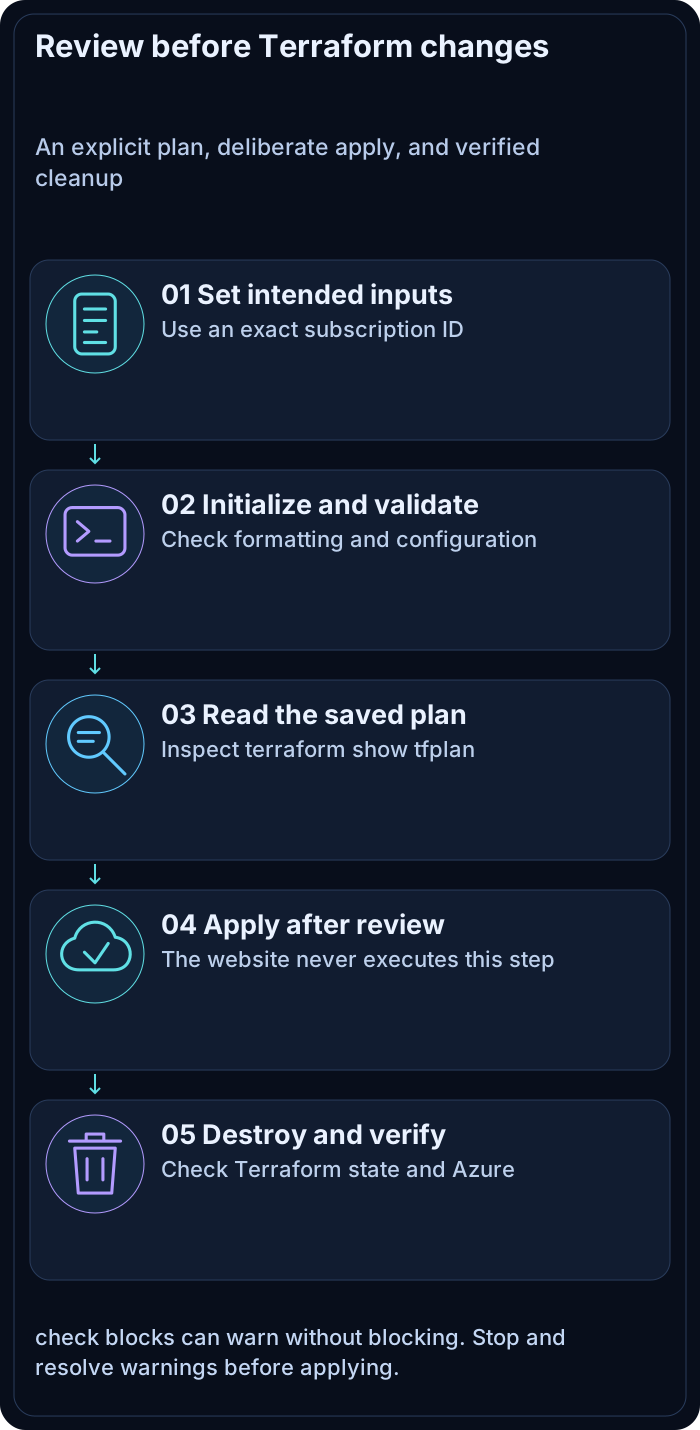
Run from the repository root in PowerShell 7:
Set-Location CLZ-280-nat-gateway-outbound
if (-not (Test-Path terraform.tfvars)) {
  Copy-Item terraform.tfvars.example terraform.tfvars
}
$subscriptionId = az account show --query id --output tsv
terraform init -lockfile=readonly
terraform fmt -check
terraform validate
terraform plan -var "subscription_id=$subscriptionId" -out tfplan
terraform show tfplan
terraform apply tfplan
Validate
$resourceGroup = terraform output -raw resource_group_name
$natIp = terraform output -raw nat_gateway_public_ip
az network nat gateway list --resource-group $resourceGroup --query '[].{name:name,state:provisioningState,publicIps:publicIpAddresses[].id}' --output json
az network vnet subnet show --resource-group $resourceGroup --vnet-name (az network vnet list -g $resourceGroup --query '[0].name' -o tsv) --name web-snet --query natGateway.id --output tsv
$natIp
Expected result:
- The NAT Gateway provisioning state is
Succeededand it references the output public IP. - The web subnet has a NAT Gateway ID.
- This control-plane-only lesson does not claim a data-plane egress test because it creates no workload.
Troubleshooting
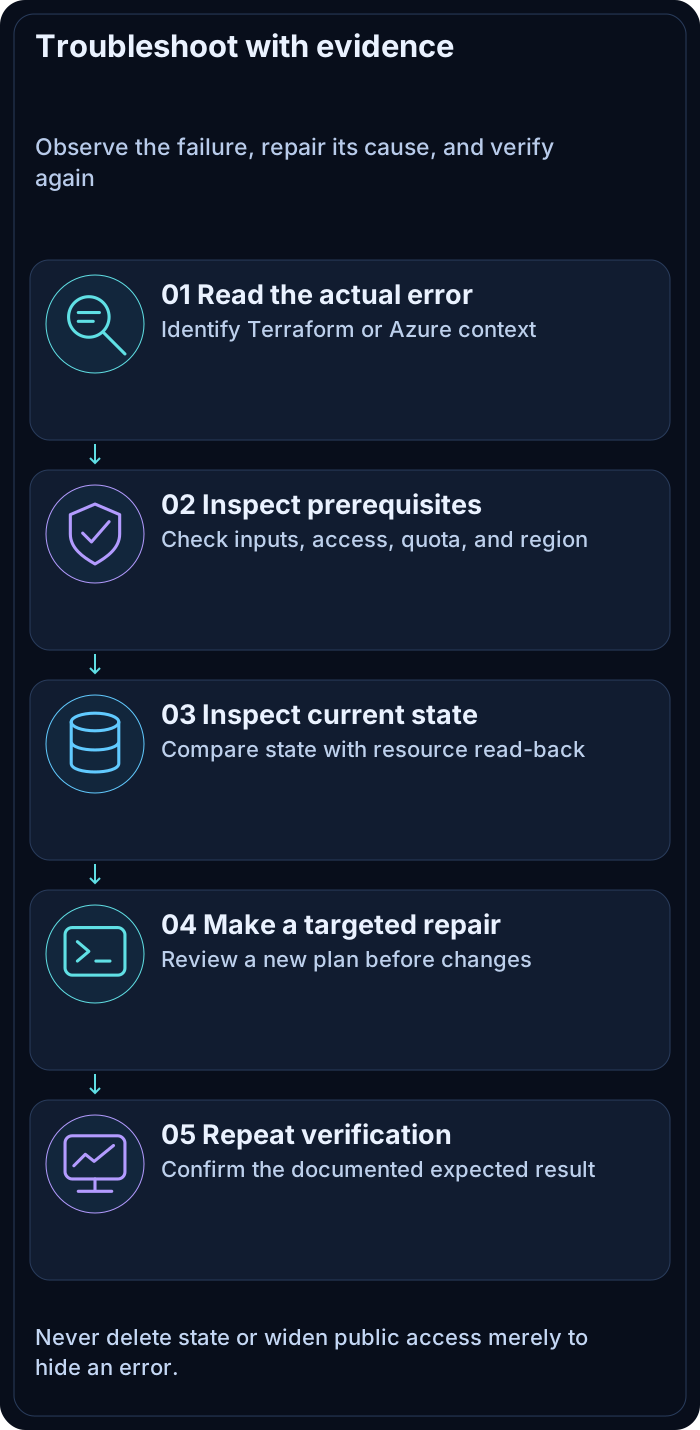
| Symptom | Resolution |
|---|---|
| A workload still uses another source IP | Confirm its NIC is in the associated subnet and no higher-level egress path overrides the design. |
| The public IP cannot attach | Use a compatible Standard, static public IP in the same region. |
| Costs appear with no VM in the lesson | NAT Gateway is billed while provisioned even without workload traffic. |
Cleanup
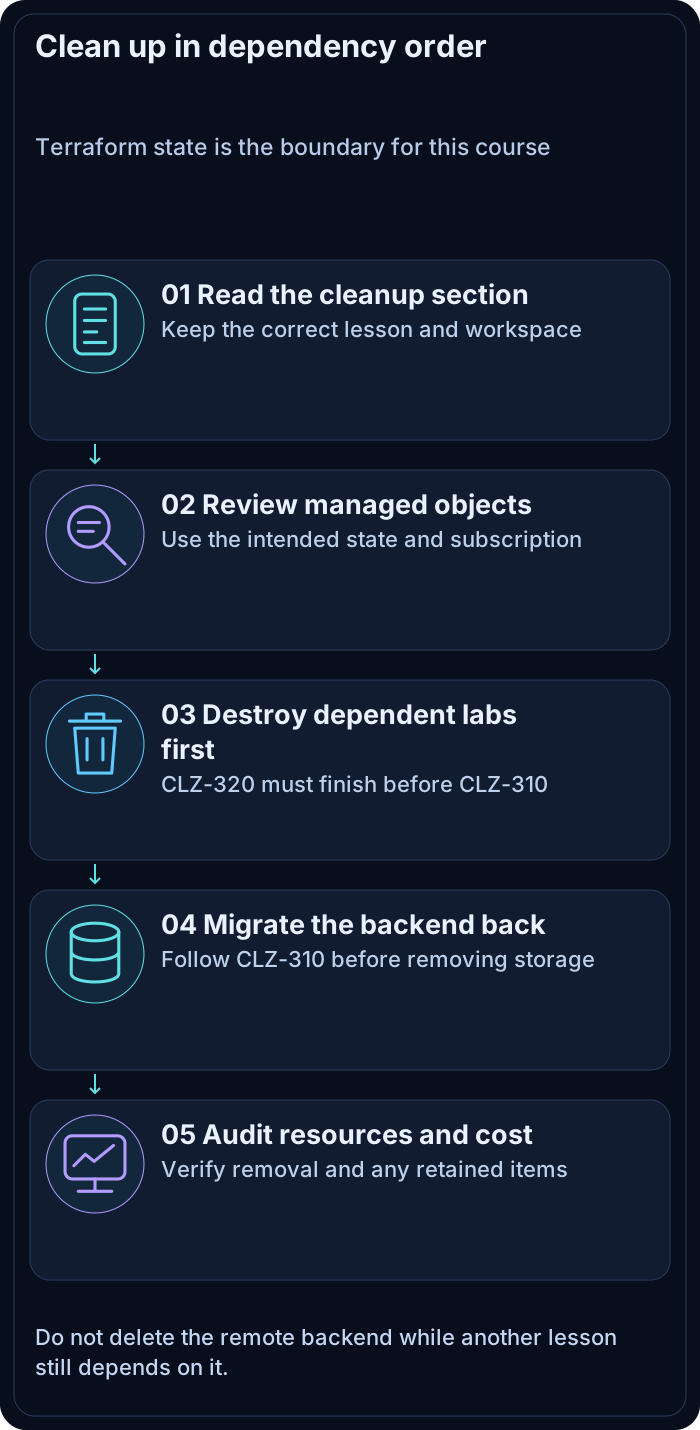
$resourceGroup = terraform output -raw resource_group_name
terraform destroy -var "subscription_id=$subscriptionId"
az group exists --name $resourceGroup
The hourly NAT Gateway and public-IP resources are deleted.
Production Delta
- Scale public IP prefixes and SNAT ports to the expected connection volume.
- NAT Gateway provides stable egress, not filtering; add Azure Firewall or another inspection/control layer when policy requires it.
Exercises
- Associate the app subnet in a temporary branch and identify the single new Terraform relationship.
- Explain why NAT Gateway does not open an inbound route to a private VM.
Navigation
← CLZ-270 - Windows VMSS Autoscaling | Curriculum | CLZ-290 - Private DNS →