CLZ-230 - Load Balancer NAT Rules
Goal
Understand per-instance inbound NAT by mapping one scoped public frontend port to RDP on a private Windows backend while HTTP remains load-balanced.
Prerequisites
- Complete CLZ-220.
- A current administrator public IPv4
/32; broad RDP sources are rejected. - Use this NAT pattern only for the lesson, not as the preferred management design.
Architecture
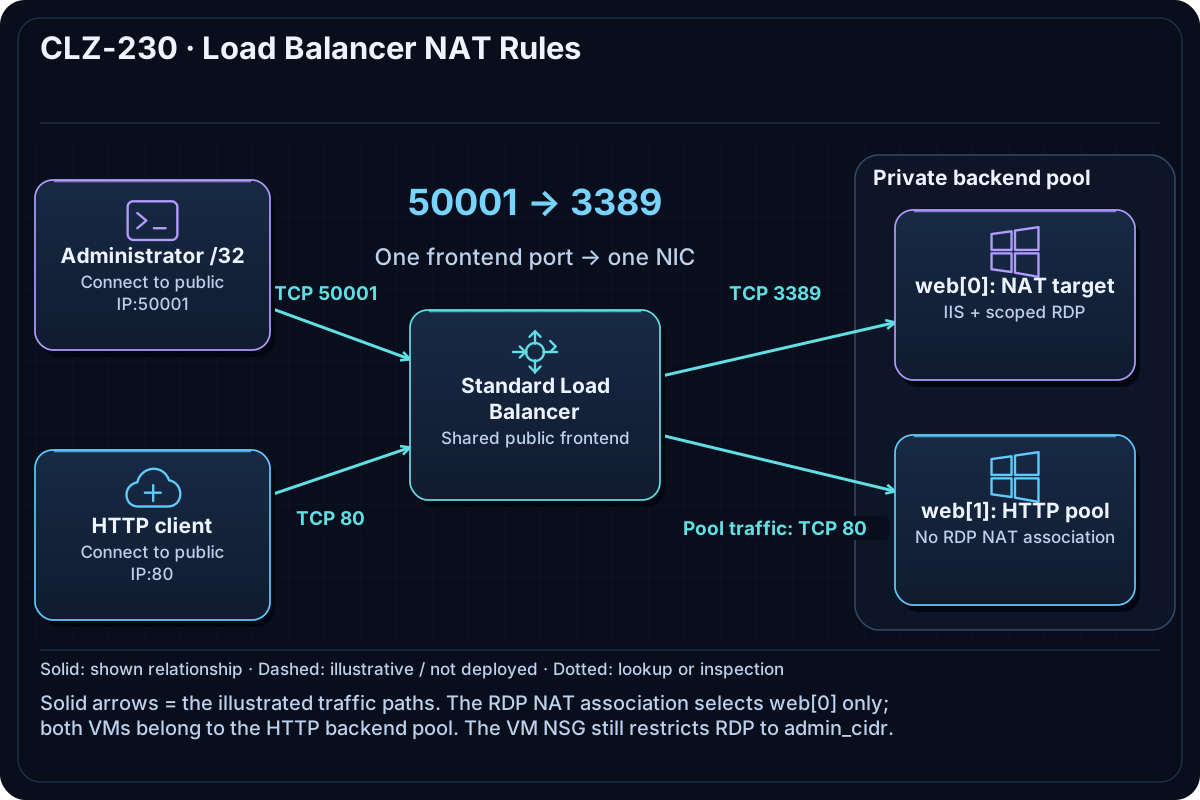
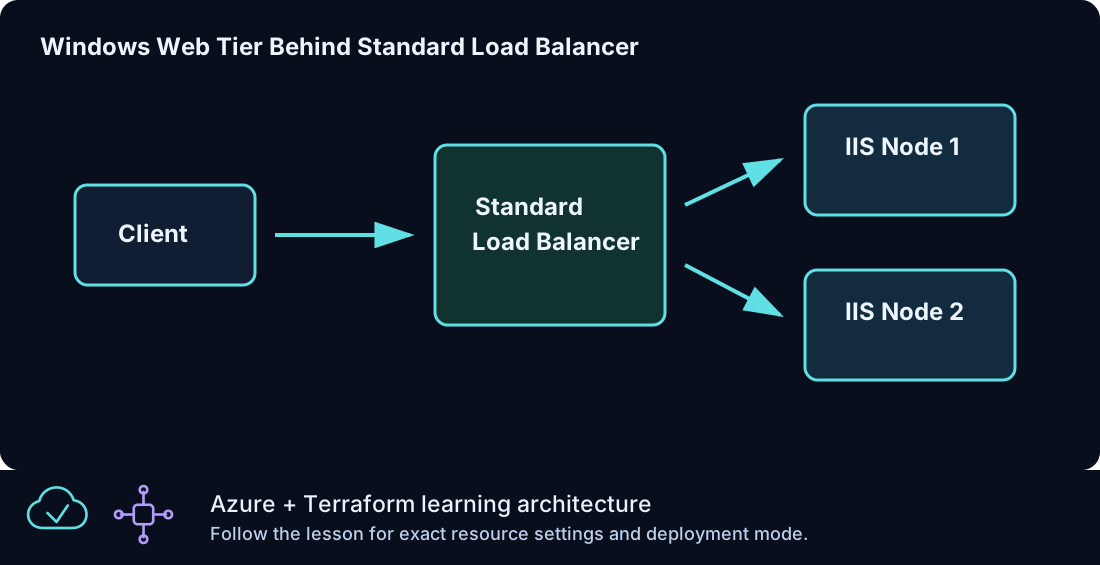
A Standard Load Balancer serves HTTP on port 80 across two Windows backends and maps frontend TCP 50001 to RDP 3389 on the first backend, web[0]. The web NSG limits that admin flow to admin_cidr. An explicit outbound rule supplies backend egress without relying on inbound SNAT.
Resources And Cost
Relative cost: Moderate. Two Windows VMs and their disks dominate; Standard public IP and outbound traffic add cost.
| Component | Purpose and principal cost driver |
|---|---|
| Standard Load Balancer and public IP | HTTP, health probe, explicit outbound, and one inbound NAT rule. |
| Two Windows IIS VMs | Both private NICs join the HTTP pool; only web[0] is associated with the RDP NAT rule. |
| Web NSG | Allows HTTP and one /32 administrator source for RDP. |
Inputs
| Input | Required substitution or decision |
|---|---|
subscription_id |
Required for plan, apply, and destroy; use the exact subscription GUID. |
environment |
Keep dev for an ephemeral lab unless testing an environment boundary. |
location |
Select a supported region with adequate quota. |
name_prefix |
Use a short lowercase prefix for derived names. |
admin_username |
Nonreserved Windows administrator name. |
admin_cidr |
Required public IPv4 /32 permitted to reach frontend port 50001. |
vm_size |
Small available Windows size. |
Keep real subscription IDs, CIDRs, and secrets in untracked terraform.tfvars or environment variables.
Deploy
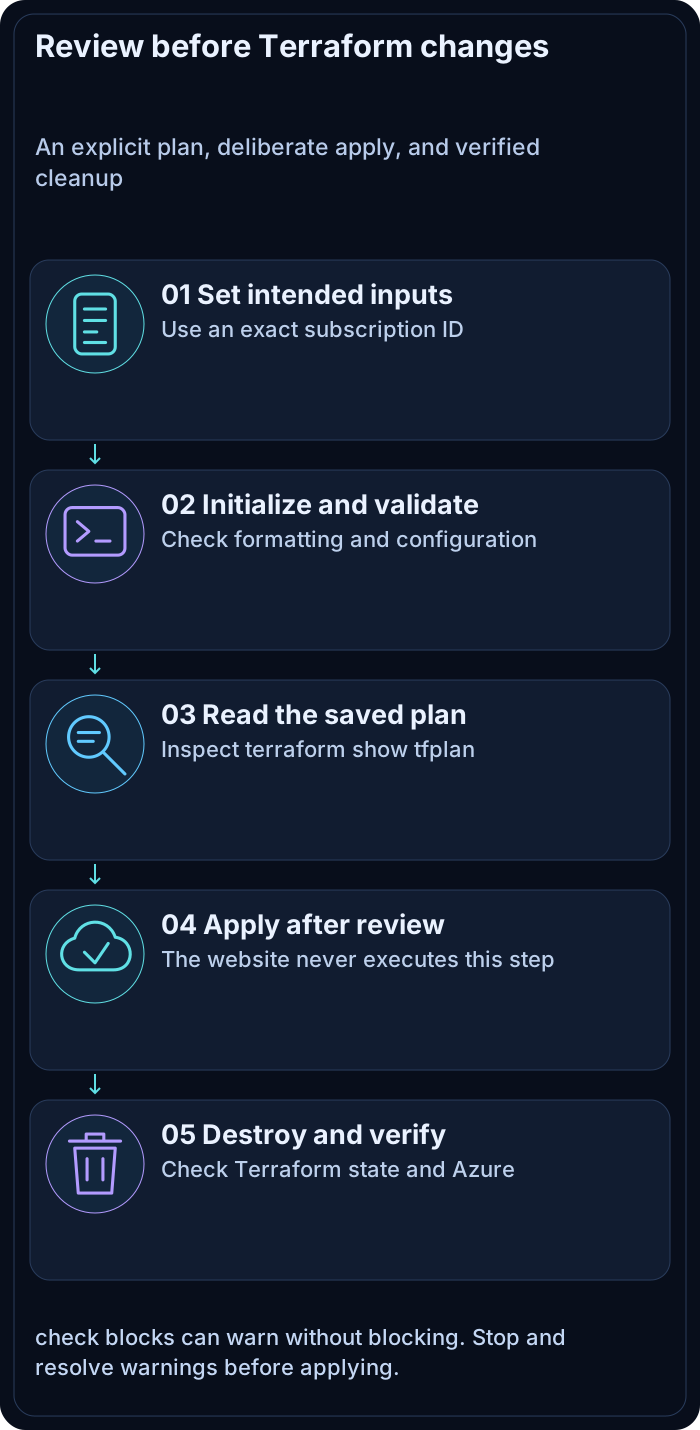
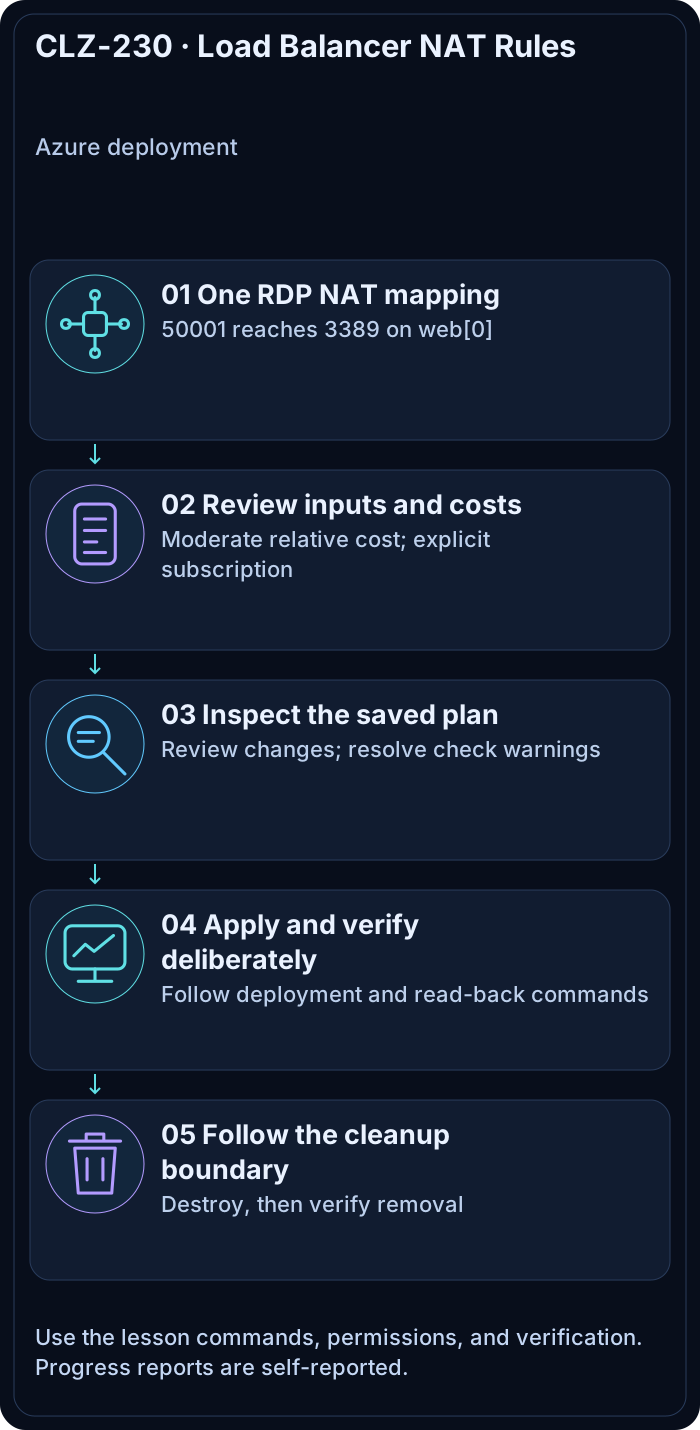
Run from the repository root in PowerShell 7:
Set-Location CLZ-230-load-balancer-nat-rules
if (-not (Test-Path terraform.tfvars)) {
  Copy-Item terraform.tfvars.example terraform.tfvars
}
$subscriptionId = az account show --query id --output tsv
terraform init -lockfile=readonly
terraform fmt -check
terraform validate
terraform plan -var "subscription_id=$subscriptionId" -out tfplan
terraform show tfplan
terraform apply tfplan
Validate
$resourceGroup = terraform output -raw resource_group_name
$ip = terraform output -raw load_balancer_public_ip
$port = terraform output -raw rdp_nat_port
Test-NetConnection -ComputerName $ip -Port $port
$lb = az network lb list --resource-group $resourceGroup --query '[0].name' -o tsv
az network lb inbound-nat-rule list --resource-group $resourceGroup --lb-name $lb --query '[].{front:frontendPort,back:backendPort,protocol:protocol}' --output table
az network lb outbound-rule list --resource-group $resourceGroup --lb-name $lb --output table
Expected result:
- The TCP test to frontend port
50001succeeds only from the configured/32. - Azure reports the
50001to3389mapping. - An explicit outbound rule exists for the backend pool.
Troubleshooting
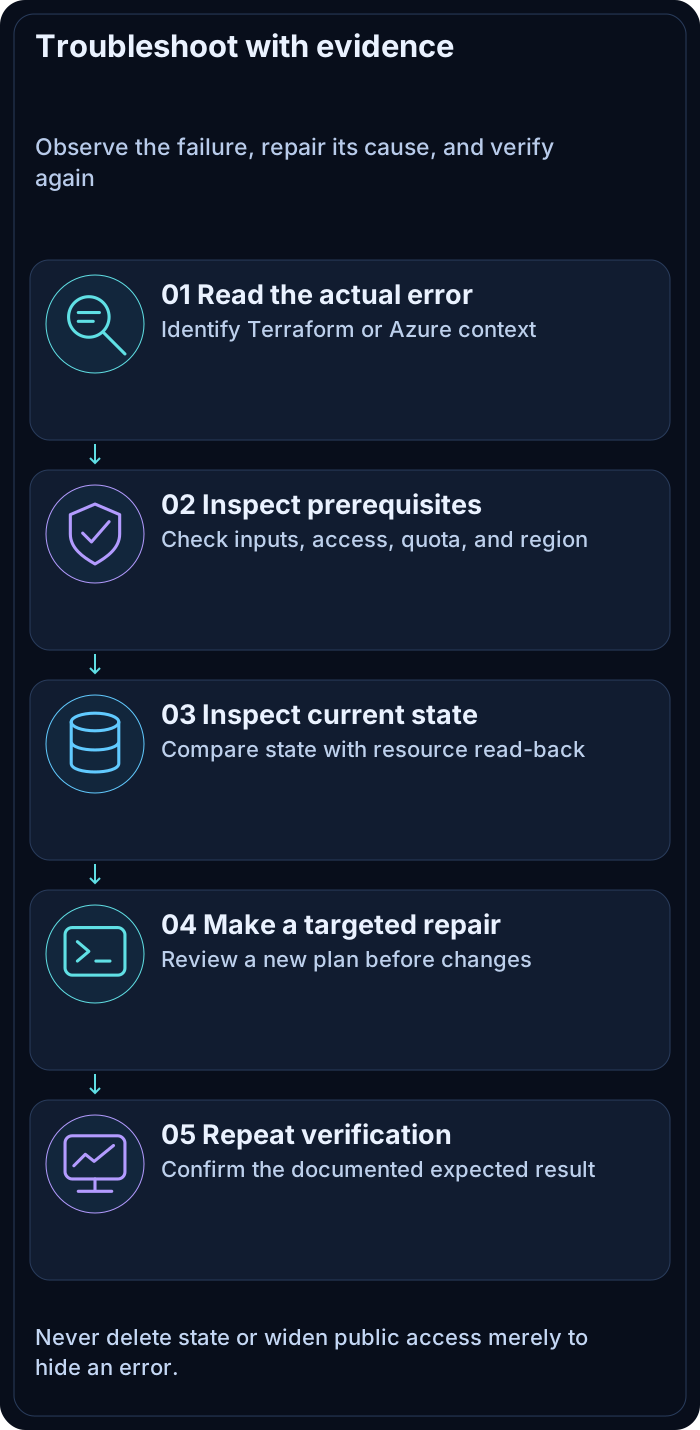
| Symptom | Resolution |
|---|---|
| Port 50001 is closed | Check your current source IP, NSG rule, NAT association, VM state, and guest RDP service. |
| RDP opens the wrong target | Inspect the NIC-to-NAT-rule association; per-instance rules are not general load balancing. |
| The safety check blocks the plan | Replace any wildcard/broad CIDR with one real administrator IPv4 /32. |
Cleanup
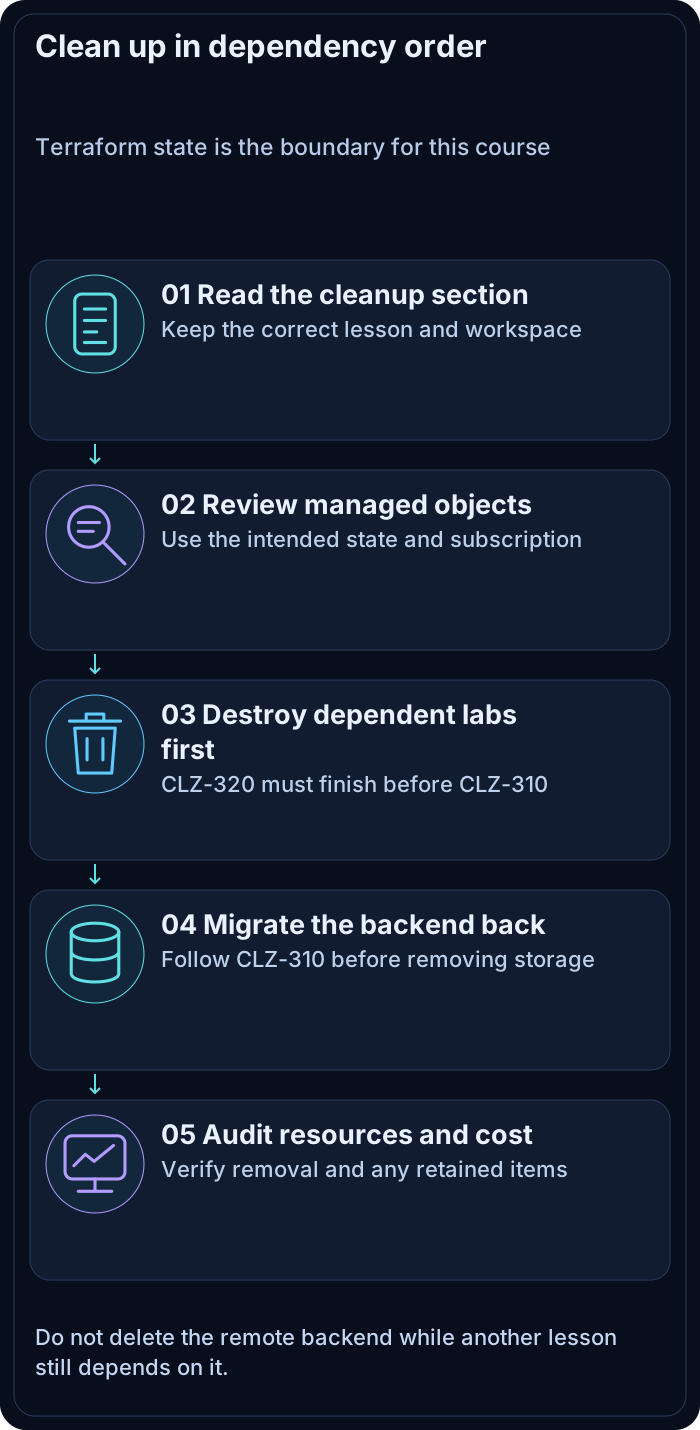
$resourceGroup = terraform output -raw resource_group_name
terraform destroy -var "subscription_id=$subscriptionId"
az group exists --name $resourceGroup
The NAT exposure, both backend VMs, load balancer, and public IP are deleted.
Production Delta
- Replace Internet-facing RDP NAT with Bastion, VPN/ExpressRoute, or another audited private management path.
- If NAT rules remain temporarily, add Just-In-Time controls, monitoring, time-bounded sources, and incident response ownership.
Exercises
- Change the frontend port and identify every place the validation command must change.
- Compare an inbound NAT rule with a load-balancing rule and an outbound rule.
Navigation
← CLZ-220 - Standard Load Balancer for Windows | Curriculum | CLZ-240 - Count with Windows VMs →