CLZ-180 - Network Security Groups
Goal
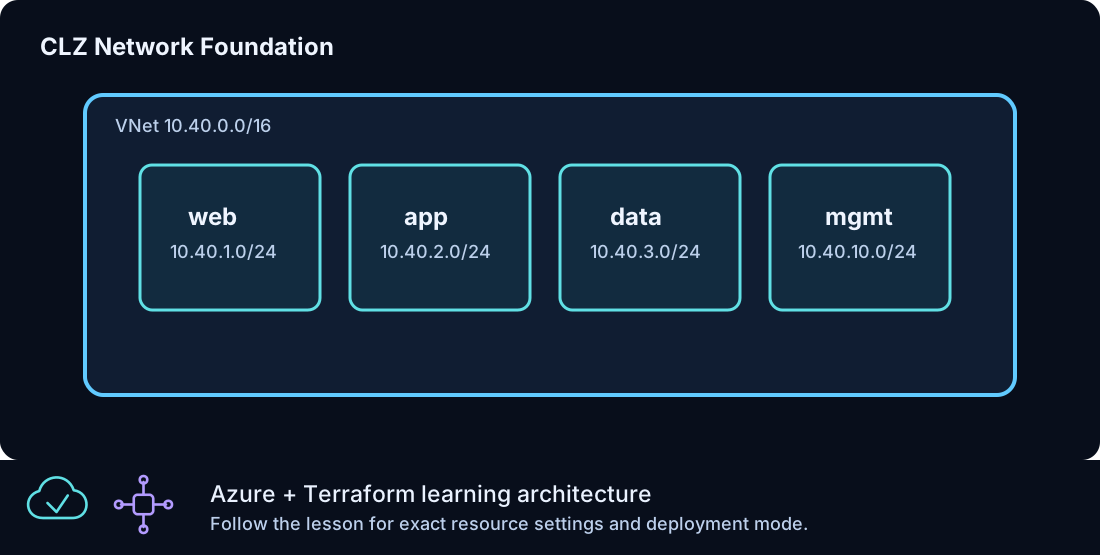
Protect the web subnet with deterministic NSG priorities, public HTTP for the teaching service, and RDP limited to one administrator IPv4 address.
Prerequisites
- Complete CLZ-170.
- Discover your current public IPv4 address and express it as a
/32CIDR.
Architecture
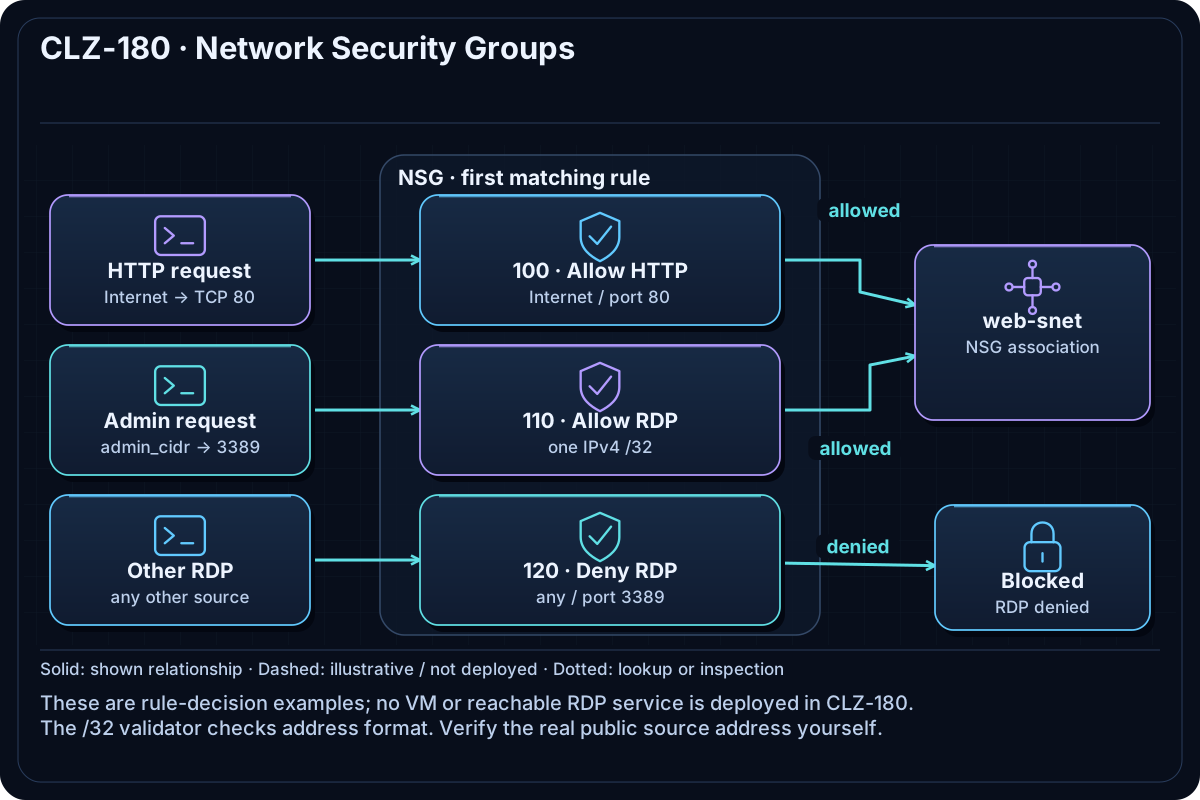
The CLZ-170 network is recreated in this independent lesson. A web NSG is associated with the web subnet. HTTP is allowed for the example service, while RDP is admitted only from admin_cidr; Azure's default deny rules handle other unsolicited inbound traffic.
Resources And Cost
Relative cost: Low. NSGs and rules have no direct charge; traffic processing and later workloads can be billable.
| Component | Purpose and principal cost driver |
|---|---|
| VNet and four subnets | Network boundary used to teach subnet-level policy. |
| Web NSG association | Applies all web rules to NICs placed in the subnet. |
| HTTP and RDP rules | Port 80 teaching access and tightly scoped port 3389 administration. |
Inputs
| Input | Required substitution or decision |
|---|---|
subscription_id |
Required for plan, apply, and destroy; use the exact subscription GUID. |
environment |
Keep dev for an ephemeral lab unless testing an environment boundary. |
location |
Select a supported region with adequate quota. |
name_prefix |
Use a short lowercase prefix for derived names. |
admin_cidr |
Required: replace the documentation address with your current public IPv4 plus /32; broad ranges are rejected. |
Keep real subscription IDs, CIDRs, and secrets in untracked terraform.tfvars or environment variables.
The CIDR validation verifies IPv4 /32 syntax, not public routability. Confirm that the value is your actual current public administrator address.
Deploy
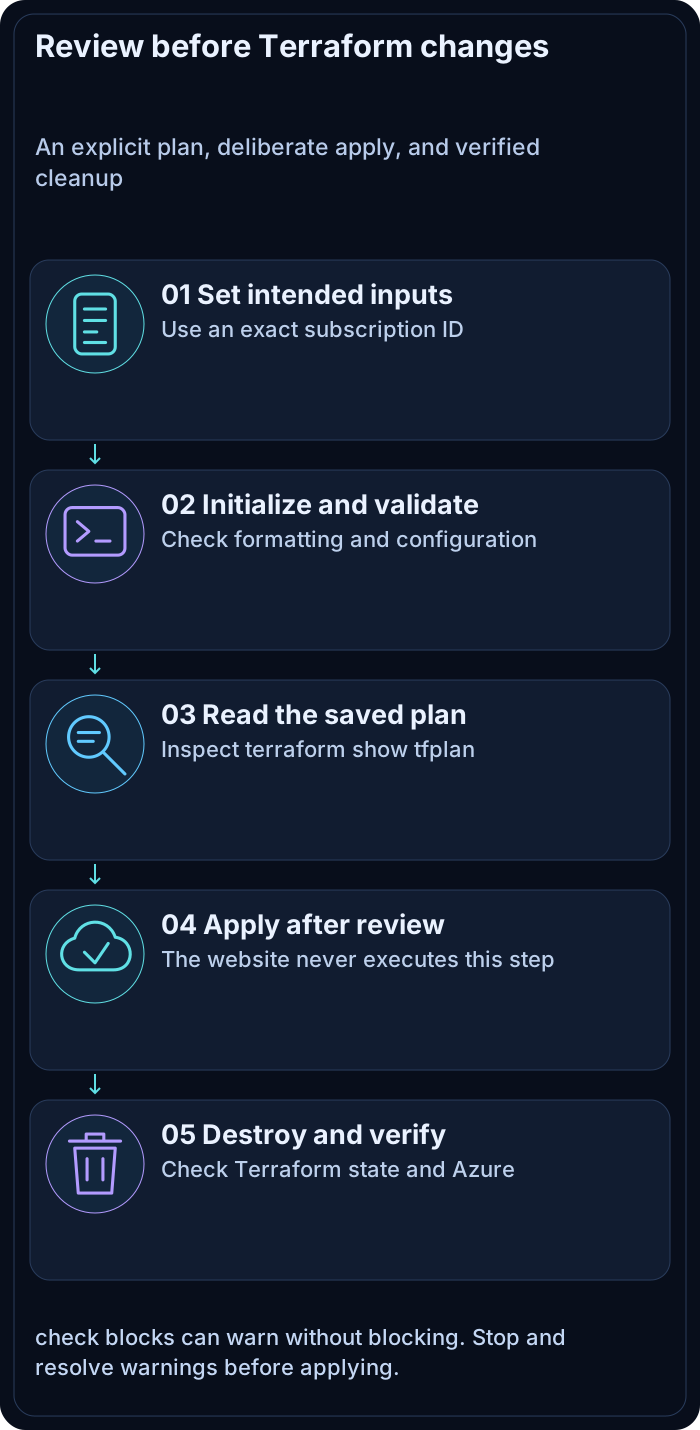
Run from the repository root in PowerShell 7:
Set-Location CLZ-180-network-security-groups
if (-not (Test-Path terraform.tfvars)) {
  Copy-Item terraform.tfvars.example terraform.tfvars
}
$subscriptionId = az account show --query id --output tsv
terraform init -lockfile=readonly
terraform fmt -check
terraform validate
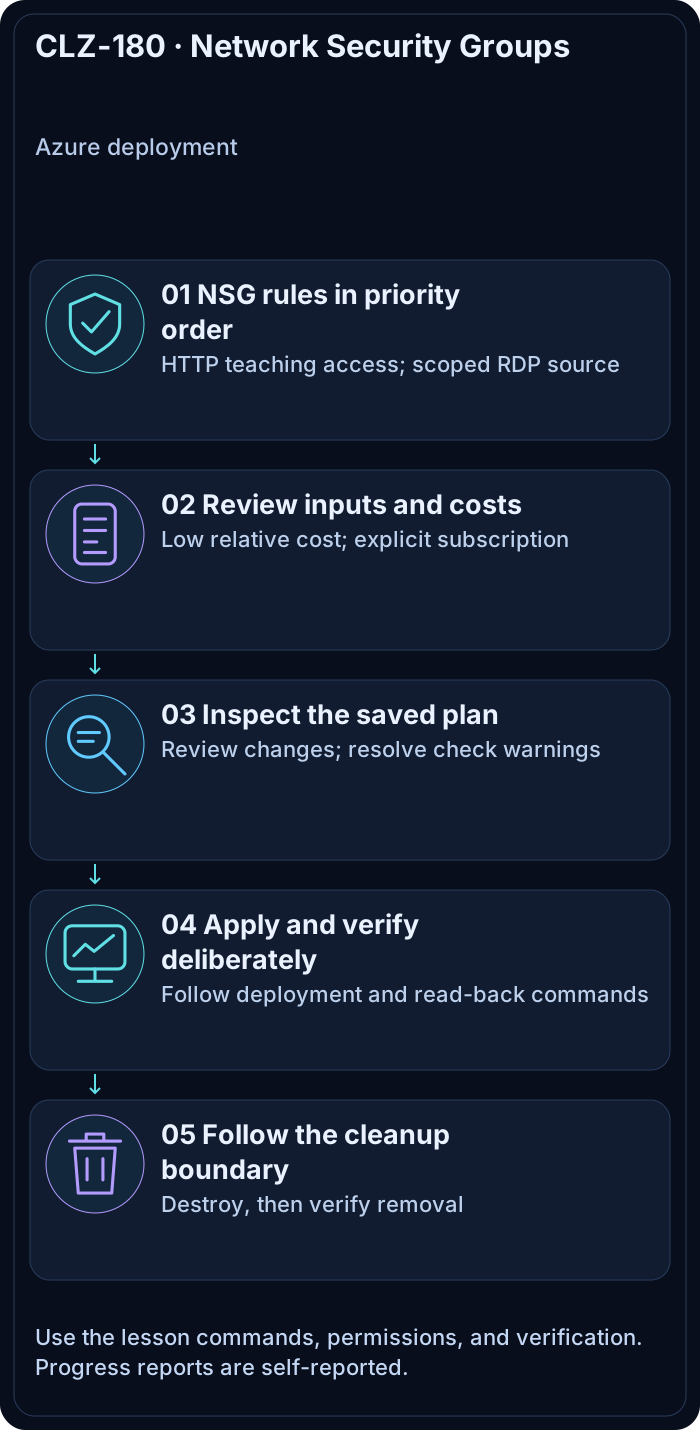
terraform plan -var "subscription_id=$subscriptionId" -out tfplan
terraform show tfplan
terraform apply tfplan
Validate
$resourceGroup = terraform output -raw resource_group_name
$nsg = terraform output -raw web_nsg_name
az network nsg rule list --resource-group $resourceGroup --nsg-name $nsg --query '[].{name:name,priority:priority,source:sourceAddressPrefix,port:destinationPortRange,access:access}' --output table
terraform plan -var "subscription_id=$subscriptionId" -var 'admin_cidr=0.0.0.0/0'
Expected result:
- HTTP and administrator RDP rules have unique priorities and
Allowaccess. - The RDP rule source is exactly the supplied
/32. - The deliberately broad negative plan fails before Azure is changed.
Troubleshooting
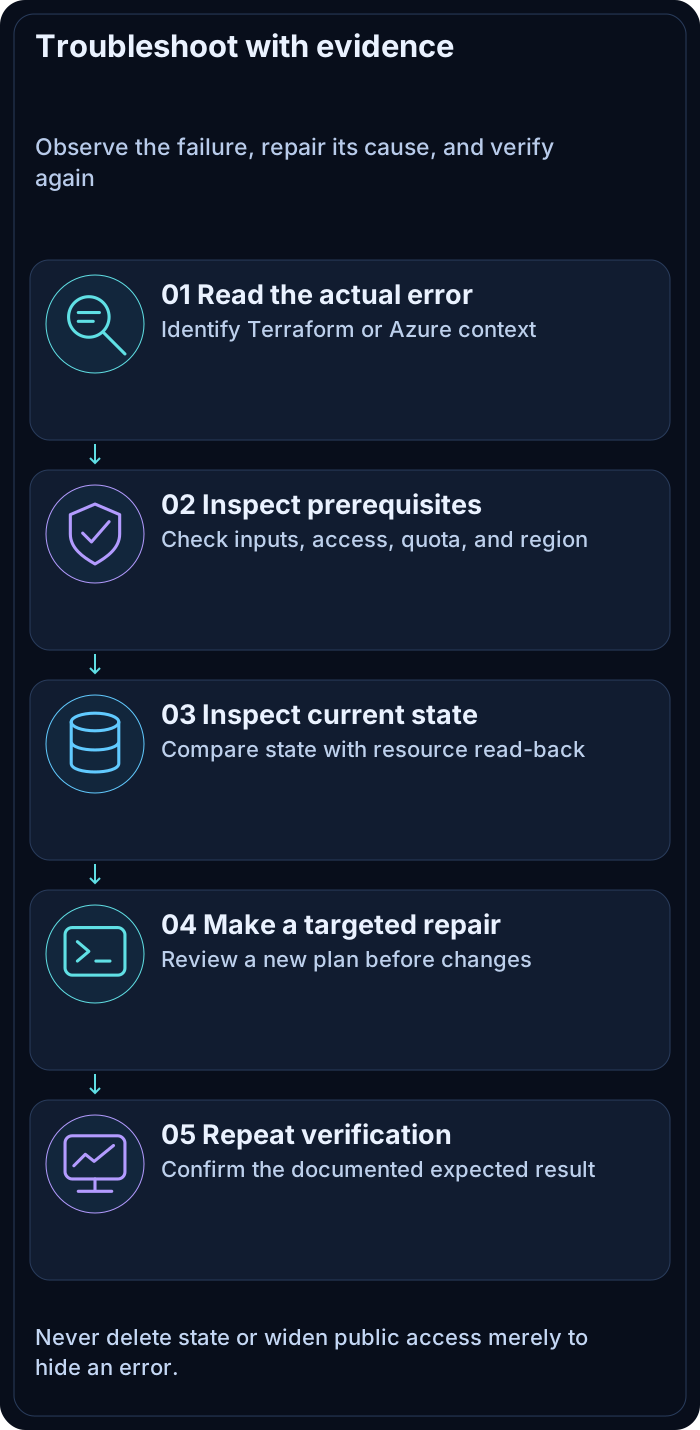
| Symptom | Resolution |
|---|---|
| The safety check rejects the CIDR | Use a routable IPv4 /32; do not substitute 0.0.0.0/0, *, or a large network. |
| A rule priority conflicts | Give each custom rule a unique value from 100 through 4096. |
| RDP remains unreachable later | Confirm both the NSG path and whether the workload actually has a public, NAT, or Bastion ingress path. |
Cleanup
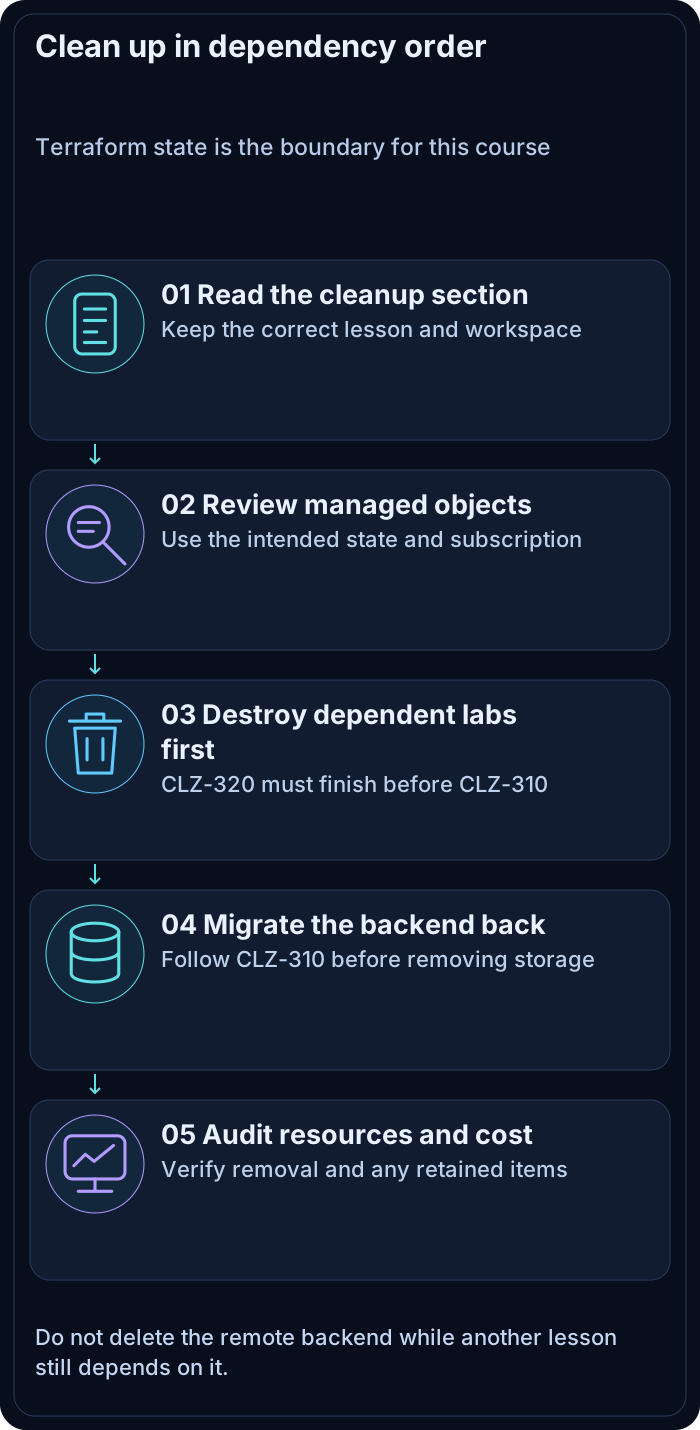
$resourceGroup = terraform output -raw resource_group_name
terraform destroy -var "subscription_id=$subscriptionId"
az group exists --name $resourceGroup
Azure CLI returns false; no NSG remains associated with a deleted subnet.
Production Delta
- Prefer Azure Bastion, Just-In-Time access, VPN, or private management over direct Internet RDP.
- Restrict web ingress to the real proxy/load-balancer path and use Application Security Groups where they simplify intent.
Exercises
- Change the RDP source to another safe
/32and identify the in-place rule update. - Add a deny rule with a valid priority and explain how Azure evaluates it against the allow rules.
Navigation
← CLZ-170 - Virtual Network Foundation | Curriculum | CLZ-190 - Windows VM Basics →