CLZ-240 - Count with Windows VMs
Goal
Use count to create and index a homogeneous set of Windows VMs, NICs, public IPs, and disks while observing the consequences of positional identity.
Prerequisites
- Complete CLZ-230.
- Quota and budget for the selected number of Windows VMs.
- A public administrator IPv4
/32for this intentional introductory public-IP pattern.
Architecture
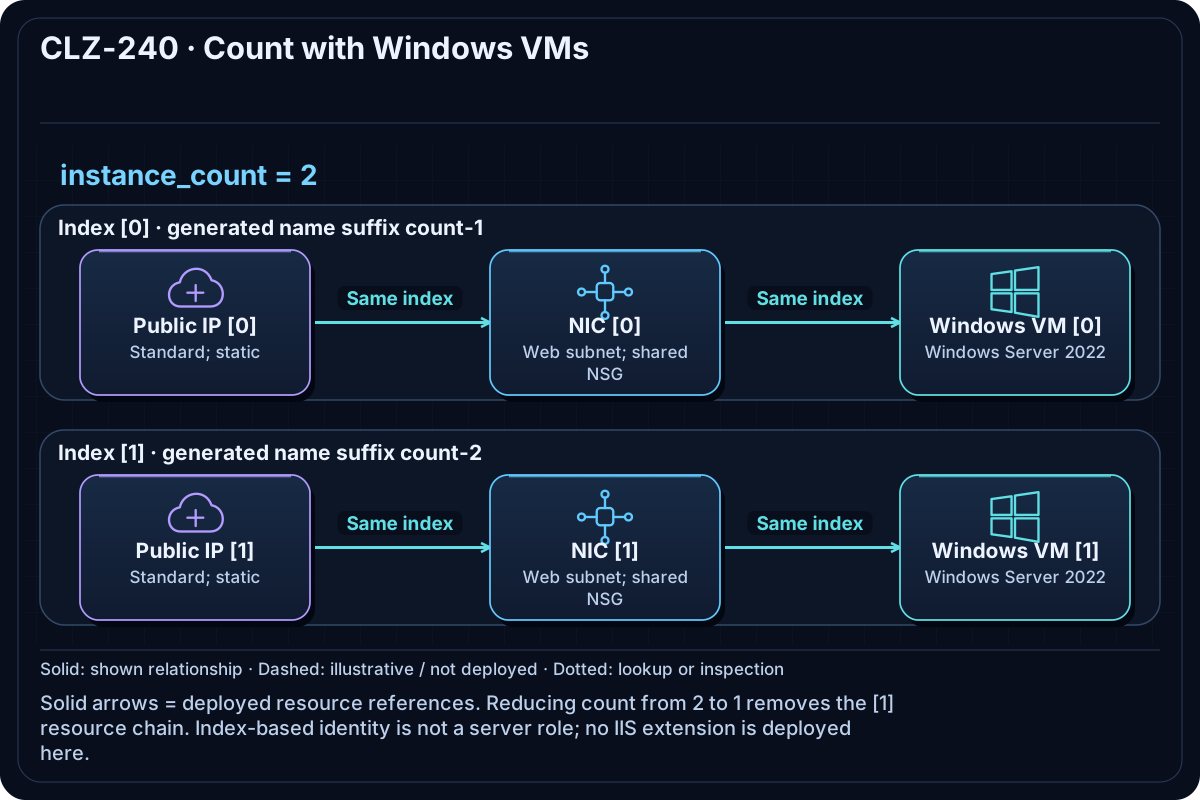
Each counted VM receives a matching counted NIC and Standard public IP. Numeric indexes connect resources and shape Terraform addresses such as [0] and [1]. The instances intentionally use public-IP egress so the lesson stays focused on count.
Resources And Cost
Relative cost: High. Cost grows almost linearly with instance_count: each element adds a Windows VM, disk, NIC, and public IP.
| Component | Purpose and principal cost driver |
|---|---|
| Counted Windows VMs and disks | Homogeneous compute set; primary cost driver. |
| Counted NICs and public IPs | One-to-one indexed network dependencies and intentional public egress. |
| Shared VNet and NSG | Common subnet policy with RDP scoped to one administrator /32. |
Inputs
| Input | Required substitution or decision |
|---|---|
subscription_id |
Required for plan, apply, and destroy; use the exact subscription GUID. |
environment |
Keep dev for an ephemeral lab unless testing an environment boundary. |
location |
Select a supported region with adequate quota. |
name_prefix |
Use a short lowercase prefix for derived names. |
admin_username |
One nonreserved administrator name used across the set. |
admin_cidr |
Required current public IPv4 /32; broad RDP access is rejected. |
vm_size |
Size applied to every counted VM. |
instance_count |
Positive integer; keep the default small to control cost. |
Keep real subscription IDs, CIDRs, and secrets in untracked terraform.tfvars or environment variables.
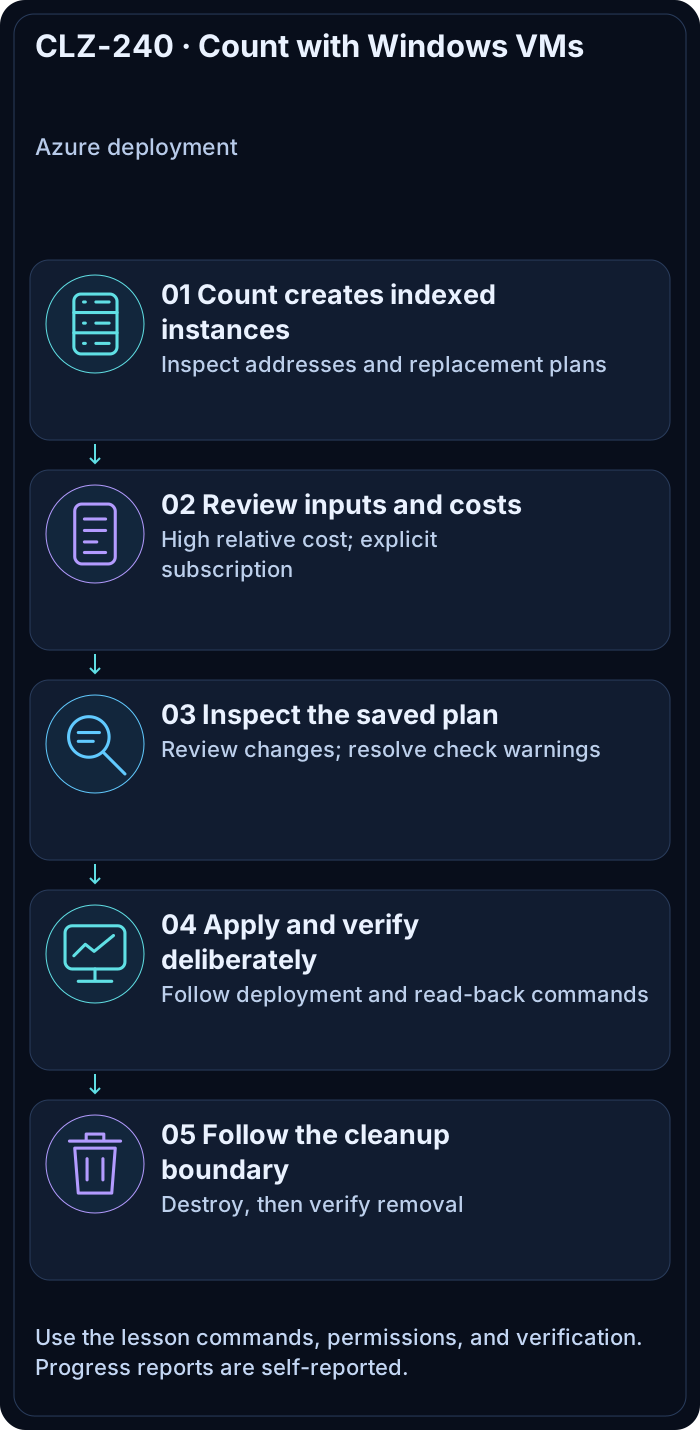
Deploy
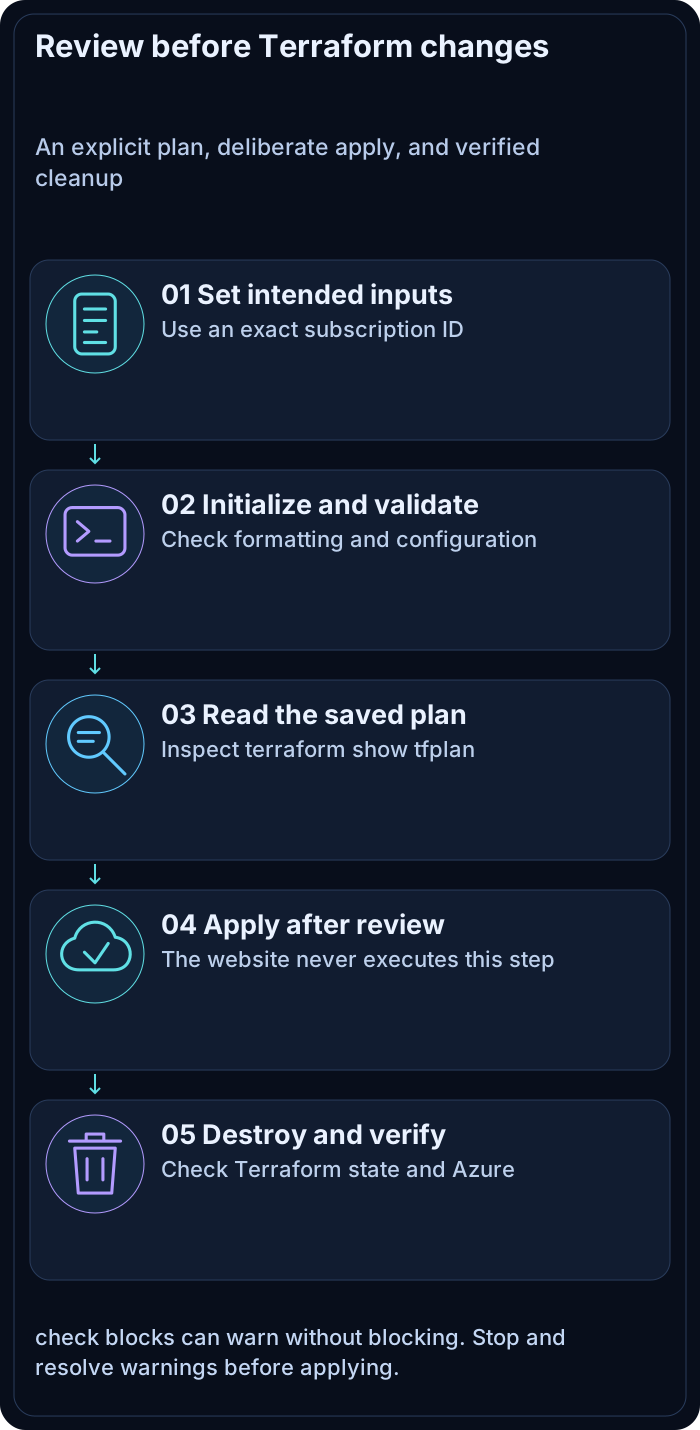
Run from the repository root in PowerShell 7:
Set-Location CLZ-240-count-windows-vms
if (-not (Test-Path terraform.tfvars)) {
  Copy-Item terraform.tfvars.example terraform.tfvars
}
$subscriptionId = az account show --query id --output tsv
terraform init -lockfile=readonly
terraform fmt -check
terraform validate
terraform plan -var "subscription_id=$subscriptionId" -out tfplan
terraform show tfplan
terraform apply tfplan
Validate
$resourceGroup = terraform output -raw resource_group_name
terraform state list | Select-String '\[[0-9]+\]'
terraform output -json windows_vm_public_ips | ConvertFrom-Json
az vm list --resource-group $resourceGroup --show-details --query '[].{name:name,size:hardwareProfile.vmSize,ip:publicIps,power:powerState}' --output table
Expected result:
- State addresses use numeric indexes consistently across VM, NIC, and public-IP resources.
- The output contains one address per requested instance.
- Azure reports the requested count and uniform size.
Troubleshooting
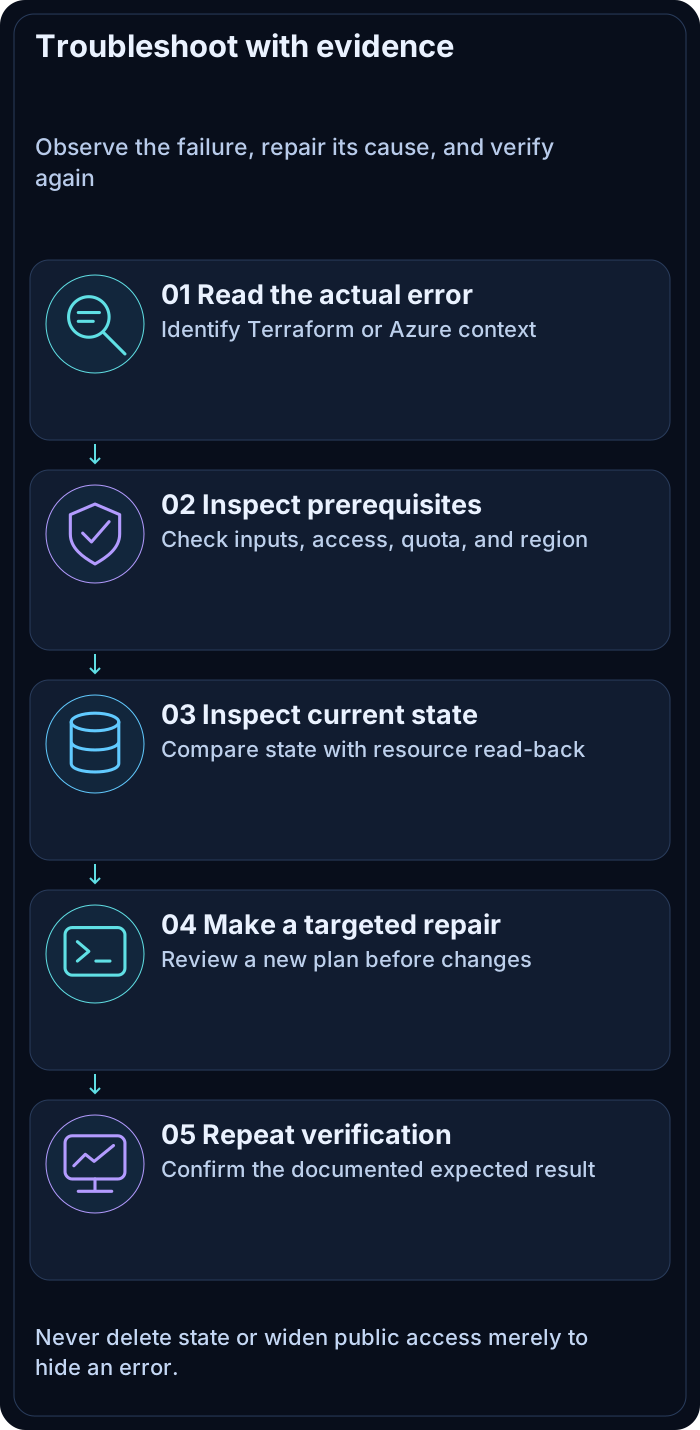
| Symptom | Resolution |
|---|---|
| Reducing count deletes an unexpected VM | Count uses positional identity and removes from the highest indexes; review the saved plan carefully. |
| A fractional count is rejected | Use a whole number; instance cardinality cannot be fractional. |
| Quota fails partway through | Destroy partial resources, reduce the count/size, or use an approved region. |
Cleanup
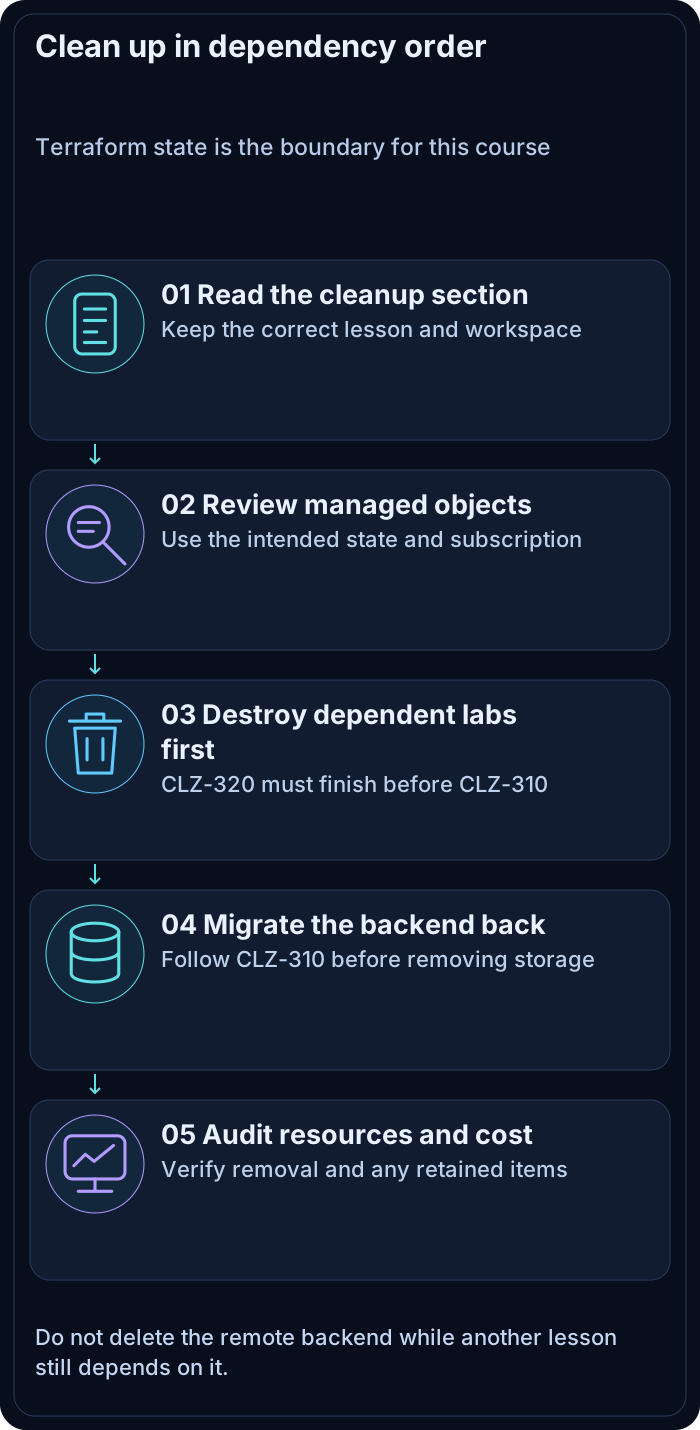
$resourceGroup = terraform output -raw resource_group_name
terraform destroy -var "subscription_id=$subscriptionId"
terraform state list
az group exists --name $resourceGroup
All indexed VMs, disks, NICs, public IPs, and the resource group are deleted.
Production Delta
- Intentional teaching exception: remove direct public VM access and use private management plus explicit governed egress.
- Use
for_eachfor durable named identity when elements are not truly interchangeable, or VMSS for one scalable workload.
Exercises
- Increase the count by one and predict every new resource address before planning.
- Remove an element conceptually and explain why positional identity can be risky.
Navigation
← CLZ-230 - Load Balancer NAT Rules | Curriculum | CLZ-250 - For Each with Windows VMs →